
Building Adult Capacity to Better Support Young Children: DCAEYC Members Explore the Impact of IECMHC

On September 10, DCAEYC members came together for a conversation that placed an important question at the center of early childhood education: What changes when we focus not only on a child’s behavior, but also on the knowledge, skills, and support available to the adults in the room?
Hosted in partnership with Georgetown University’s Thrive Center for Children, Families, and Communities, the virtual session, Why the Child Is Not the Problem: Building Adult Capacity to Respond to Challenging Behavior, featured Dr. Neal Horen and Shai Idelson in a discussion about Infant and Early Childhood Mental Health Consultation, commonly known as IECMHC, and its role in strengthening early childhood programs, supporting professionals, and improving outcomes for young children.
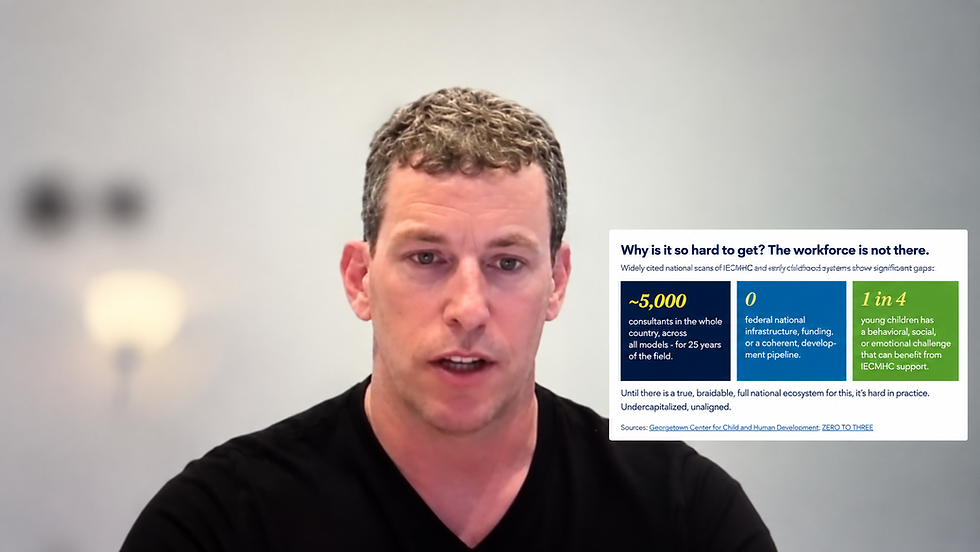
Shai Idelson opened the conversation by challenging a common way of thinking about children’s behavior. “The child is not the problem. The child is a child, but the way that adults are equipped or ill equipped to respond and process and understand these behaviors is what makes all the difference.”
Dr. Neal Horen explained that distinction clearly: “It’s not about treating a child. It’s not about intervening with a child. It’s about changing how an adult comes to see, think about, and respond to that child.”
Participants explored how effective consultation can strengthen classroom environments, reduce educator stress, support staff retention, and help early childhood education professionals develop practical strategies they can use consistently. Dr. Horen also emphasized that the relationship between a consultant and the professional receiving support is central to the effectiveness of the work.
While consultation has demonstrated positive outcomes, the number of consultants available nationally remains far below what is needed. Idelson and Horen discussed new approaches developed through Georgetown’s Center of Excellence for Infant and Early Childhood Mental Health Consultation, including practical training pathways that can prepare professionals from a wider range of backgrounds to develop consultation competencies.

For DCAEYC Executive Director Berna Artis, expanding knowledge within programs is an important part of strengthening both the workforce and the environments in which children learn. “The more we know, the better we can help children,” Artis said. “To me, this directly impacts teachers’ well-being.”
Her comments also connected professional development to what happens every day in early childhood settings. When professionals have stronger tools for understanding behavior, responding to individual needs, and supporting one another, that knowledge benefits children, families, colleagues, and the broader program community.
The discussion included DCAEYC members who shared their own experiences with consultation, access to professional learning, classroom realities, and the challenge of translating outside recommendations into practices that can be sustained throughout the day. Their perspectives reinforced an important point from the session: effective support must be practical, accessible, and connected to the realities of the professionals doing this work.
DCAEYC is grateful to Dr. Neal Horen, Shai Idelson, Georgetown University’s Thrive Center for Children, Families, and Communities, and every member who contributed to this conversation.

Comments